Flat illustration → silk garment → on model
A designer's flat sketch of a lehenga, with embroidery motifs placed on it, is taken through two transformations: first rendered as a photorealistic silk garment, then placed on a female model for a lookbook shot. Every motif the designer placed survives both steps, pixel-faithful — only drape, lighting, and pose change.
The three stages
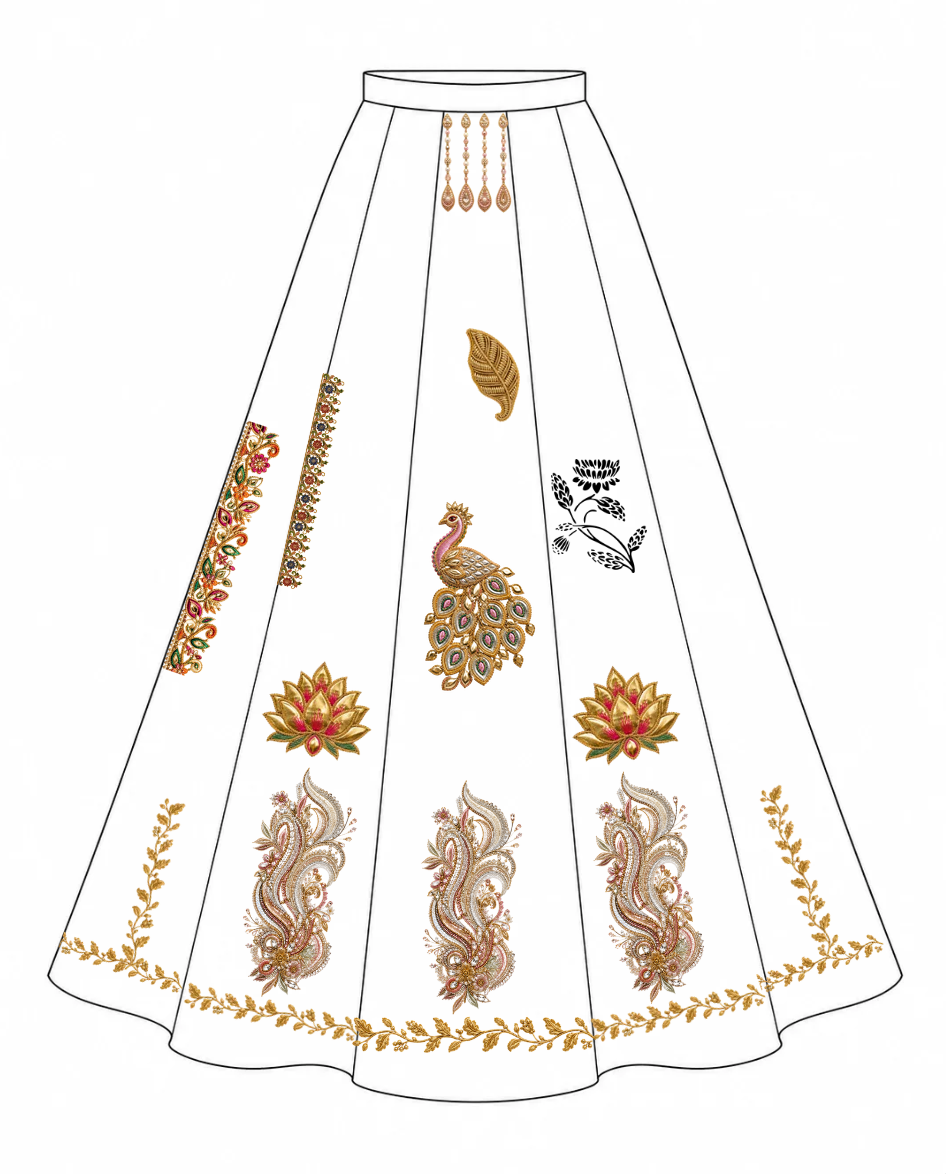
designer flat
indicative placements
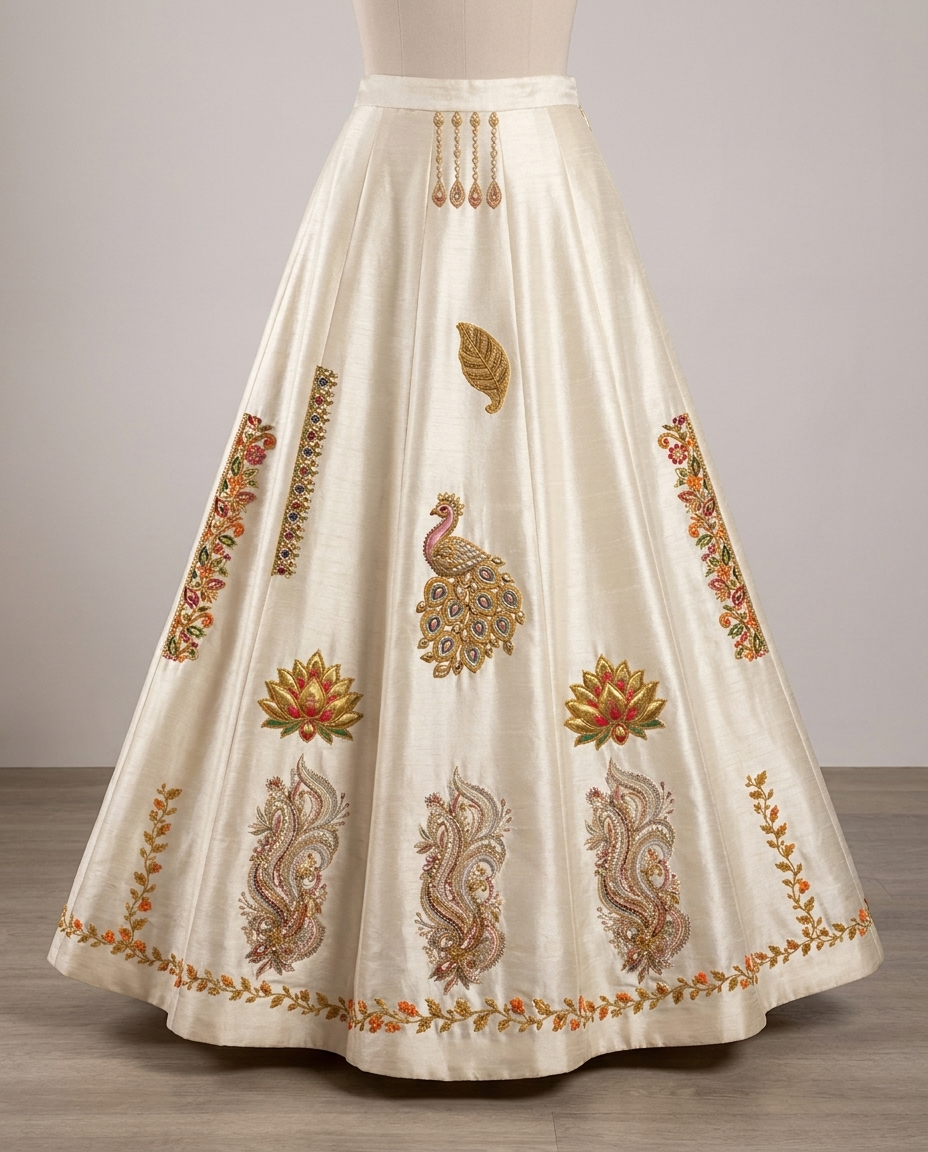
motifs preserved
drape + studio light
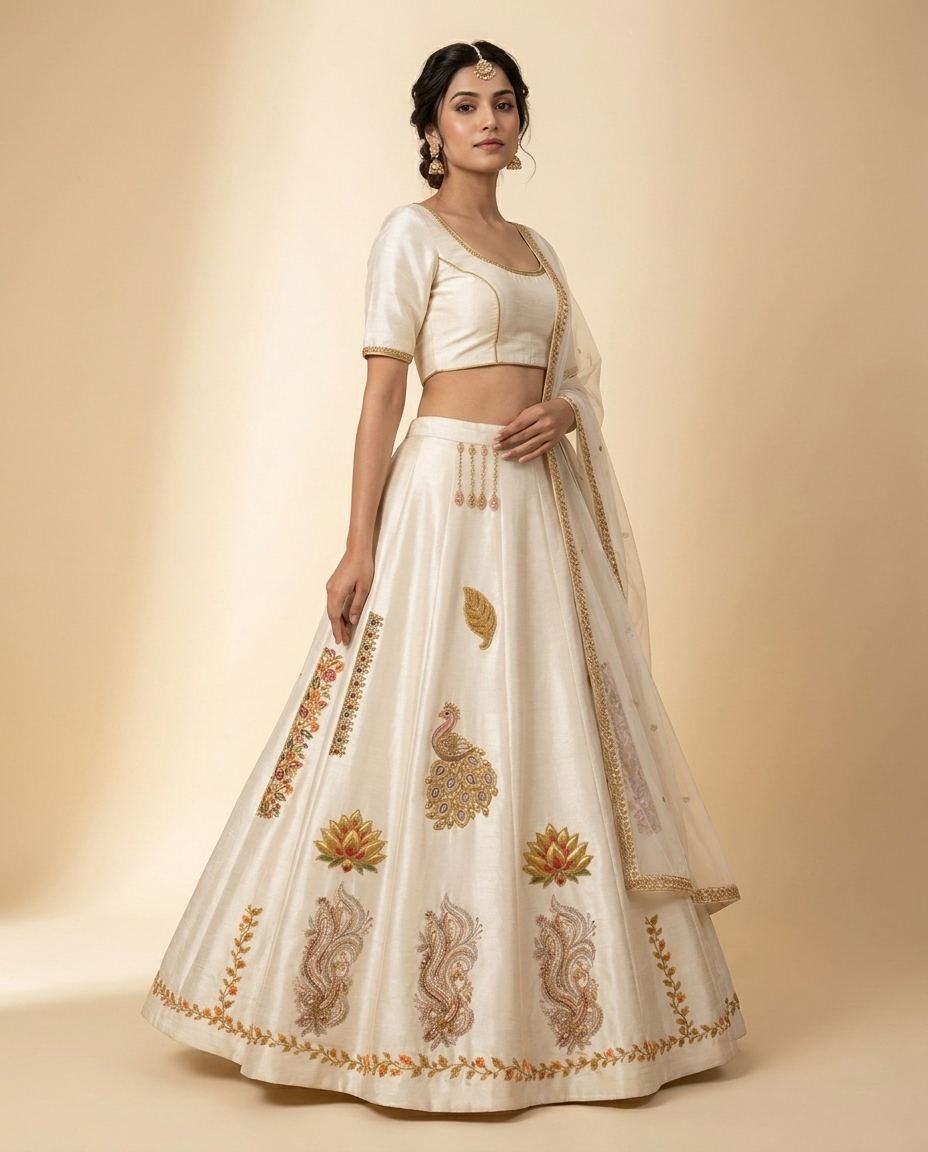
editorial pose
full styling
What the model preserved across both transforms
| Element from the flat sketch | Stage 2 (silk) | Stage 3 (on model) |
|---|---|---|
| Multi-colour peacock at upper centre | Same palette & outline, drape applied | Same palette & outline, now curving with the body |
| Vertical floral spray on left panel | Mirrored onto right panel as instructed | Both panels visible, both preserved |
| Marigold flowers mid-skirt | Same exact orange, flanking peacock symmetrically | Same exact orange, now lit naturally on silk |
| Three paisley butis lower centre | Same cream/gold, same arrangement | Same cream/gold, now warped by the flare |
| Partial creeper-vine border at hem | Extended around the full circumference | Visible around the hem on the model |
| Plain black khaka sketch in upper-right shoulder | Removed — recognised as a tracing guide | Removed |
Why this matters
For a designer, the slow and expensive parts of the workflow are deciding the motifs, their colours, and their placement. The flat sketch represents that final, signed-off creative decision. What follows — rendering the silk, photographing the garment, photographing a model wearing it — is traditionally a long, costly chain of sampling, tailoring, and studio shoots.
This pipeline collapses that chain to two model calls, while guaranteeing the design itself is never silently restyled by the model. The output isn't "AI's idea of your design" — it's your design, lit and worn.